St Peter's School and Church, Walworth
Monday, 25 July 2016
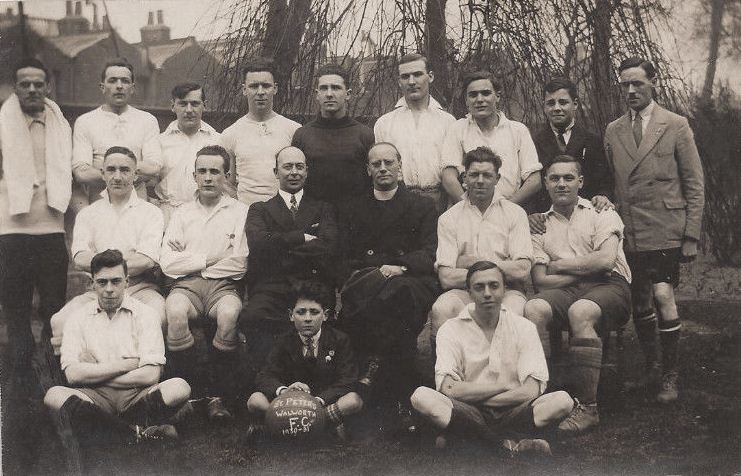
St Peter's Church Football Team 1930/31
This photograph of the St Peter's Church football team has recently surfaced. The boy in the front row is holding a ball dated 1930/31 season.
I can only assume that the man in the dog collar is the Rector of St Peter's - Gilbert Spofforth Reakes - who ministry at the church lasted from 1924 until 1937. At the time of the photo he was 40 years old and was married to Kathleen. They had two children.
We will be fascinated to find out the names of the other men in the photograph, which looks like it was taken in the churchyard.
Thursday, 26 May 2016
Keith Baugh introduces Bob Marley to Peckham
If there was a prize in the 1970s for the coolest teacher in South London, it would surely have been presented to Mr Baugh the Art teacher at Peckham Manor School.
Keith Baugh was one cool dude admired by all the pupils from the 1st Year to the Upper 6th. In contrast to the more authoritarian figures at the school, he was arty and trendy, and got on great with everyone. He even kept his guitar in his classroom, one of the art rooms at the Technical Wing, and occasionally played it for the kids. How cool was that! Forty years later, with his shock of white hair and beard, he looks like he could have stepped out of Led Zeppelin or the Who or another classic rock band.
One of Keith's crowning achievements was inviting musicians Bob Marley and Johnny Nash to play an acoustic gig at the school. This was in 1972 when Bob Marley was relatively unknown and Johnny Nash was the big star. The concert, to a couple of hundred lucky souls, may even have been the springboard to Bob Marley's success as one of the twentieth century's most influential and much loved recording artists.
The BBC's The One Show (click on You Tube link above) recently filmed a segment at the old Peckham Manor School site where Marley and Nash played. The school is long gone but the three main buildings in Peckham High Street, Sumner Road and Cator Street all remain.
Keith revisited his old workplace and met up with a couple of former pupils who witnessed the show. One of them was Walworth Road's very own George Dyer - the Threadneedle Man.
I was a 12 year old at Peckham Manor School at the time but I somehow managed to miss the performance. Despite that, having so many West Indian mates, meant reggae was the backdrop to my school days and played a big part in my music listening. We had the Tighten Up LPs constantly on the turntable at home, whilst the sounds of Toots and the Maytalls, Jimmy Cliff and U Roy filled the ether in Peckham and Camberwell.
Mr Baugh always remained in my memory, and it was a great thrill to meet up with him at one of his art and photography exhibitions a couple of years back. Check out his website here.
Jack McInroy, May 2016.
Keith Baugh was one cool dude admired by all the pupils from the 1st Year to the Upper 6th. In contrast to the more authoritarian figures at the school, he was arty and trendy, and got on great with everyone. He even kept his guitar in his classroom, one of the art rooms at the Technical Wing, and occasionally played it for the kids. How cool was that! Forty years later, with his shock of white hair and beard, he looks like he could have stepped out of Led Zeppelin or the Who or another classic rock band.
One of Keith's crowning achievements was inviting musicians Bob Marley and Johnny Nash to play an acoustic gig at the school. This was in 1972 when Bob Marley was relatively unknown and Johnny Nash was the big star. The concert, to a couple of hundred lucky souls, may even have been the springboard to Bob Marley's success as one of the twentieth century's most influential and much loved recording artists.
The BBC's The One Show (click on You Tube link above) recently filmed a segment at the old Peckham Manor School site where Marley and Nash played. The school is long gone but the three main buildings in Peckham High Street, Sumner Road and Cator Street all remain.
Keith revisited his old workplace and met up with a couple of former pupils who witnessed the show. One of them was Walworth Road's very own George Dyer - the Threadneedle Man.
I was a 12 year old at Peckham Manor School at the time but I somehow managed to miss the performance. Despite that, having so many West Indian mates, meant reggae was the backdrop to my school days and played a big part in my music listening. We had the Tighten Up LPs constantly on the turntable at home, whilst the sounds of Toots and the Maytalls, Jimmy Cliff and U Roy filled the ether in Peckham and Camberwell.
Mr Baugh always remained in my memory, and it was a great thrill to meet up with him at one of his art and photography exhibitions a couple of years back. Check out his website here.
Jack McInroy, May 2016.
Wednesday, 28 October 2015
Walworth Under Fire (Part Eight)
Walworth Under Fire
The memoirs of Rev. John Markham,
Continued from Part Seven
On October 28th, 1940, the Air Raid warning sounded at the usual
time, about 6pm. The crypt shelter was full, even before the warning. Everybody
had their usual settling down period - perhaps a few songs, families talking,
eating the food they brought with them before they laid down to get some sleep
in their usual places on improvised bedding, deck chairs and even on the bare
stone floor. The shelter wardens, mostly members of the congregation, including
one of my churchwardens, little Mr Morgan, getting on in years had the usual
busy time, fetching drinking water from the tap up to the church vestry, doling
out tea from the club bar, made by some of our ladies, and then settling down
for a rest themselves, as the night wore on, and our area seemed to be having a
quiet time. What bombs were dropped seemed to be aimed at other parts of London
by scattered groups of planes, sent over night after night, not only to cause
damage, but to wear down the morale and the working ability of the civilian
population.
We wardens were on patrol, or in some cases were resting in the
crypt, or the post, snatching some food or sleep if possible. My messenger and
I, however, had a busy time around midnight helping the police, when we had
alerted, to seek out and arrest some intruders in the erstwhile film studio and
former Baptist Chapel a few yards from the Rectory. We had heard them at work,
looting the belongings of bombed out houses, stored there by the borough. We
failed to catch them: all seemed quiet. Jenner and I returned to the Post, and
then decided that we would make a circuit of the area, to contact the wardens
on patrol, whom we had not been able to see for several hours. As usual, we
mounted our blitz bikes, brakeless, lampless, and started off down the street alongside
the churchyard.
We heard the explosion of one or two bombs in the distance, and
carried out our usual drill - falling off the bikes without stopping. As we hit
the ground, five bombs exploded around us, so that we could see the orange
flashes; two in the churchyard beyond the church, two others, as it turned out,
in the church, and one in the garden of one of the small houses beside us,
throwing some of the dirt on us, as we sprawled in the gutter. We got up, and
rushed round to the other side of the church, which appeared, in the moonlight,
to be undamaged, expecting to find that the houses on the other side of the
churchyard had been hit. No signs of damage there. Then I heard a dull,
confused murmur from the crypt, and a dusty figure struggled among the sandbags
in the doorway at the foot of the steps, leading down to the shelter, crying
out ‘Help!’ In a flash I guessed that the orange bursts that I had glimpsed
through the windows of the church as I sprawled on the road belonged to bombs
which had exploded in the east end of the crypt. I shouted to the dusty figure, ‘I will get
help!’ and ran round the church, into the Post, dashed off a message for the
telephonist, giving a rough estimate of 200 casualties, guessed from the
probable number in that part of the crypt which appeared to have been hit, and
then, leaving the wardens there to start in the crypt, ran round to the school
next door, shouted to the R.A.F. Balloon crew, ‘Get your beds ready, and plenty
of boiling water, and I will send all casualties round here.’
In a remarkably short time, the Mobile Unit, with a doctor on
board, and a complement of nurses, armed with the life-saving morphia so
essential in dealing with the shock of major casualties, drove up, and I
directed it to the school, where they were able to work on the casualties in
full light, and plenty of space. The balloon crew worked like Trojans, helping
in the crypt to bring out casualties, and having a boiler full of water on the
ready. In a remarkably short time, a steady stream of injured were going
through the process of being diagnosed by the doctor, cleaned up and given
First Aid. Stretcher Parties arrived, together with Light Rescue teams. As a
result of my original message, giving 200 possible casualties, Control made it
a major incident, which entitled them to call on Regional help from other
boroughs, so that we had ample services on the site within a matter of half an
hour at most. We were fortunate that no more bombs fell that night: indeed, we
were probably the victims of a lone plane on its way home, dropping its load
across the borough. They proved to be 50 kilogramme semi-armour piercing bombs,
part of a stick of twelve.
Those early hours of that morning were so hectic that my memories
of it are confused. I remember that I was very busy rushing backwards and
forwards, from the Post to the school and the church, seeing that the various
services were directed and parked. Early on, the Post was invaded by walking
casualties, brought out of the crypt, or found staggering about in the
churchyard, dazed and covered from head to foot in white dust. I snatched up a
couple of First Aid boxes and shoved them into my wife’s hands, as she sat with
my daughter in her arms in the kitchen, both in their night-clothes, for it had
been a quiet night, and had enabled them to get to sleep, until the crypt was
hit. I said ‘I am sending in some light casualties to you: get on with it.’ I
dashed off to the churchyard to see what was going on, just in time to find AlfMorgan, my
elderly churchwarden, crawling out of one of the windows of the crypt, where
the explosion had blown away the protecting sandbags. His foot was badly
injured. I got someone to take him along to the school. On one of my visits to
the Post, I found an old lady, who lived just round the corner, sitting in one
of chairs, where one of the wardens had put her. She was grey with dust from
head to foot, and where her skin was exposed it was beginning to peel off.
Otherwise, she did not seem to be injured and was fully conscious. In fact, she
died later from the effects of blast.
My estimate of casualties was not far out: later we reckoned on
250 seriously hurt, and over 70 killed, with hundreds of lesser casualties, caused mainly by splinters
from the wooden partitions, dividing the various parts of the crypt. The blast
had torn the matchboarding into countless needle-like splinters, which rifled
into people and their belongings. Later on, when we salvaged the hundreds of
handbags left in the crypt, we found them filled with minute fragments of wood,
which had pierced the leather or cloth of the bags without tearing them
noticeably.
The blast in the confined space of the crypt, was greater than it
might have been because both bombs exploded on the floor of the crypt, having,
in one case gone through the roof and ceiling of the church, then the organ, on
through the thick stone floor. Being semi-armour piercing and dropped from a
height of perhaps 20,000 feet, they literally bored their way through these
successive layers, and in the case of the second one, through a 12 inch beam,
literally like a gimlet, without dislodging it from the floor of the gallery
which the beam was supporting. The combined blast produced some bizarre
results, some of which were studied by Air Ministry experts later on. On that
night, one which was perhaps the strangest of all was the injury incurred by
one young man, who undoubtedly owed his life to the rapid manner in which he
was attended by the First Aid services and the speed with which he was
transferred to hospital. When the bombs fell, he was lying asleep on the floor.
The blast hurled a wooden kitchen chair through the air, and a slab of stone,
likewise projected by the blast, drove the leg of the chair through his hip,
where it was firmly embedded. When he was found, his rescuers sensibly left the
chair-leg embedded, detached the remains of the chair, and sent him off to
hospital. Within three months, he was back at work in his factory.
Another strange case was that of a young woman, who was sitting in
a chair by the brick pier supporting one of the arches in the crypt. One of the
bombs exploded just the other side of this brick pier, blowing to bits a whole
family, six members of which I commended to Almighty God a few days later at a
funeral service in a neighbouring church. The young woman, just a few feet from
them, was uninjured, except for a burst eardrum.
The heavy brick arches and piers caused many strange effects of
similar nature. One of these concerned the injury to Alf Morgan, whom I had
found crawling on hands and knees in the churchyard. He had been asleep on the stone
floor; the blast ripped past him, missing him entirely, except for one foot
which happened to be in its path. This was reduced to a pulp, so that he was in
hospital for many weeks.
Another of my shelter wardens, Mrs Curtis, was resting in one of
the club arm chairs, when the blast lifted a huge stone slab, forming the
ceiling of the crypt and the floor of the church, and shattered it, as it fell.
Half of the slab crashed down, its fall broken by the central heating pipes,
and pinned her in the armchair. When the wardens found her, she was sitting
there, perfectly conscious, comparatively unhurt, unable to move, with rusty
water dripping from the pipes onto her head. The Rescue workers managed to free
her, and I found her being treated in the school. She was badly bruised on the
thighs, but otherwise all right.
Two of my wardens were not so fortunate. They were off-duty in the
crypt, when it was hit. One was the 19 year old, rather unfit, only son of a
widow. His name was Kenneth Ballard. The other, Arthur Townsend, was an older
man, with a wife and family. One of the problems, with which I had to deal
with, as we got most of the casualties away to hospital in two hours, was the
disposal of the dead. I decided that the considerable risk of panic among the
wardens and the local population would be heightened if they had to see rows of
dead laid out, waiting for the mortuary vans. I had all the bodies taken
straight into the undamaged West End of the church, where they were laid out in
rows in one of the aisles. In the morning there were 35 stretchers of the
remains waiting for the vans. Their blood stained the stone flags: I was glad
that I was able within a week to establish our altar on that very spot, where
we offered the sacrifice of our worship and prayer for them and ourselves, and
all the world, during the following years.
I shall always remember them.
Those stretchers represented less than half the number of those
who died either at the time, or later on in hospital. One of the latter remains
particularly in my memory, on account of its tragic irony. It concerned a young
coloured girl, one of the communicant members of the congregation, aged about
sixteen. She was lying on the floor of the crypt when the bombs hit. A fragment
of one tore into her leg, and finally lodged in her groin. Gangrene set in as a
result, so that the hospital, despairing of her life, wanted to amputate her
leg. She steadfastly refused to allow this, fighting for her life through
something like fifteen operations, to triumph after long months, walking again.
She was finally evacuated somewhere North. However, she had a small injury from
the shrapnel of the bomb to one of her fingers. She was a keen pianist. So she
came back to London to have a comparatively minor operation to straighten the
finger. She died under the anaesthetic.
Having visited her during the fight that she made in hospital, and seen
her courage and indestructible spirit, I grieved greatly for her. I hope I have
the privilege of meeting her in the hereafter.
One Italian family was wiped out in the crypt shelter, where they
had taken the week’s takings of their business. We had the job of counting bags
of coins and bundles of pound notes, some of which were shredded to thin strips
by the blast. One sixpence had been melted by the heat of the explosion and
formed itself into a sharp silver spike which protruded from the handbag like a
needle.
Dawn and the ‘All Clear’ wailing of the sirens found us very
weary, particularly, my wardens, many of whom had plunged into the work of
extracting the injured from the tangle of debris and darkness of the crypt. I
was luckier in that I had been too busy directing the whole operation to have
much close contact with the dead and injured. Inevitably, those who had been
down amongst it all were suffering from shock, as were the whole neighbourhood,
when they came out of their shelters, checked up on their friends and
relatives, many of whom were in the crypt. There was a shocked feeling about,
heightened by the belief that many had cherished that the crypt was a safe
shelter - an illusion which I had never shared.
By this time, the Control had sent down a senior officer to take
over my job, so that, for the first time after three or four hours, I was able
to look into the Rectory kitchen to see how Eileen and our baby daughter were
getting on. My last view of the latter had been of her sitting in her little
chair in her night clothes in the Wardens’ Post, watched over by one of the
telephonists. The milling crowd of wardens, entering and leaving, hardly
noticed the small figure. Tears were not far away.
I found her and her mother in the kitchen, which was a scene of
desolation. The floor was covered with bits of blood-stained cotton wool and
rags. Eileen had treated more than twenty casualties single-handed. One of them
was an elderly, rather bald man, with a scalp wound. He had wandered round the
large kitchen table, brushing his bleeding scalp on the baby's washing, which
was hanging from a line covered with his blood. Susan was on Eileen’s lap. I
swept up all the mess that I could and took it into our small backyard. I
cannot remember having any breakfast. What I do remember is the instinctive
determination to get some sleep, for I knew that we were likely to have another
long night of alert and bombs. My wardens were more shattered than I was: the
parish was near panic. I felt that I must be fit to deal with what might come.
‘I'm going to bed.’ I said to Eileen, who asked ‘What shall I do if anybody
cones down to see you? ‘ ‘Tell them I am sleeping, and must not be disturbed.’
I think that I went out
like a light, and slept, fully clothed in my A.R.P. overall and gumboots, on
the camp bed in the scullery. I was oblivious to all the comings and goings in
the Post next door. Apparently, my Bishop came: Admiral Evans, the Regional
Commissioner, likewise. Eileen kept them firmly at bay. When I awoke about
lunch time, things were quieter. I was able to deal with some of the aftermath,
such as seeing that the dead were removed from the church.
A few hours later, the warning went, and the usual night raid
began. The wardens were very jittery. It was not long before we were dealing
with another problem - an unexploded bomb in Bronti Place, the inhabitants of
which had to be evacuated there and then. It was a long night, but luckily for
our area, one without further casualties. I was glad that I had got some sleep,
when I did, as I had to hold things together very much that night. The
following days were busy, for we had hundreds of inquiries about the
casualties. I gave Bertram Calver, my curate, the task of checking up on their
whereabouts, for they were treated at various hospitals, and then transferred
to the evacuated sections of the larger units, such as St. Thomas’ and Guy’s.
One of them was at Brookwood in a very large and gloomy Mental Hospital
building. Another was housed in Some Army huts. I could not afford much time to
visit them, as the journey was often long and complicated. A more lugubrious
task for Bertram was that of checking queries that arose concerning the bodies
of the dead. One in particular produced a particularly thorny problem. Someone
identified a body as that of his mother, and had her buried. Later on, the
family of the lady in question refused to accept the body labelled with her
name, and eventually it was indeed proved that she had been claimed by the
wrong family and had already been buried under another name. It was decided
that the body should be exhumed and reburied under her real name. The Town Hall
officials were about to go through the difficult and lengthy process of getting
a Home Office exhumation order, when Calver reported it to me. As she had been
buried in consecrated ground, I rang up the Bishop's Legal adviser, who
affirmed that we did not need a Home Office order, the Bishop being able to
authorise the exhumation and reburial. This was done quickly, and I took the
funeral. The original coffin was encased in another larger one for this second
burial - the only time I have seen this done.
It was extremely difficult, also, to establish the exact identity
and number of those who were killed in the crypt, as we kept no records of
those who sheltered there. The coroner in some cases wanted proof of the fact
that certain people, known to have sheltered in the crypt on most nights, were
actually there on the night of the bombing. After months, it was decided that
the crypt would have to be cleared completely of all the debris, which would
have to be sifted carefully for any evidence of identity. Rescue teams were
sent down, to work in masks for two hour shifts, over a period of six weeks. I
had to go down with them for quite a lot of the time, as being the person most
likely to know the significance of any find. It was a gruesome business, as the
blast had literally lifted the whole church slightly, causing the brickwork to
part a fraction, with the result that fragments of clothing and human flesh
were caught between the bricks. I remember taking an Air Force officer from the
Air Ministry down there for an inspection of the damage. After a few minutes, I
noticed that he was very silent and looking a trifle green. He said ‘I am
sorry: I must get out of here.’ I had got so used to the smell that I was
unaffected. Nevertheless, I was glad when the crypt was cleared, and I cannot
say that I went down there more than was necessary. For one thing, it was open
to the four winds by that time, and all the cats in the neighbourhood, many of
them having lost their homes, infested the place with their fleas.
We could not use the church
for several weeks after the bombing. We had our services, many of them
funerals, in St. Mark’s, in East Lane, which was placed at our disposal by
Wellington College Mission. However, my curate and I got to work on the problem
of making a temporary church in St Peter’s, which had a wide aisle at the west
end, running across the church, and the floor of which had not been affected by
the blast. The main force of the bombs had damaged the nave and choir, but left
the aisles and the chancel intact. One bomb, as I have already described, had
gone through the organ, and heaved it so violently from below that the pipes
were thrown in all directions, giving it a very drunken appearance. The plaster
statue of the Blessed Virgin Mary, only recently installed near the organ and
pulpit, was smashed, only the face of our Lady being recognizable. Yet, the
plaster crucifix, just above the pulpit, and within three feet of the statue,
was untouched. In the choir, we had a Bechstein Grand piano. This too had been
thrown into the air, and broke one of its legs, when it came to rest. The
second bomb had gone through the floor immediately in front of the Lady Chapel
Altar, and some of the blast from it took out the whole of the adjacent window,
and smashed the stone top of the altar, without disturbing the cobwebs on the
chains of a hanging sanctuary lamp nearby. The High Altar was completely
undisturbed. Pews in the body of the church were lying higgledy-piggledy. Most
of the windows seemed to be undamaged, but white cracks showed in the plaster
ceiling, where the roof had been jerked up by the explosions.
Calver and I managed to put the High Altar on rollers and
manoeuvre it across the chancel and down the aisles, to place it under one of
the windows on the South side, so that it faced across the church in the west
end aisle. With help we moved some of the smaller pews and chairs to furnish
this aisle, which made a temporary church for our use. I obtained the services
of a local builder, who took up the boarding floor under the damaged pews in
the nave, and used it to make a partition from the west end gallery to the
church floor, thus closing our improvised church off from the damaged nave. We
papered these boards inside, so that it was draught-proof. We moved the font
from its position in the central aisle, to the end of the temporary church, and
the grand piano likewise. Two Tortoise, army-type, coke stoves, each end,
provided the heating. In this fashion, we were fully operational within six
weeks of the bombing, and this was the home of our congregation until the end
of the war. We were much more fortunate than the majority of the churches in
the neighbourhood, which were either blown to pieces or burnt. St Peter’s
escaped burning by a very small margin. We had clouds of incendiary bombs all
round us: I used to sweep up the unexploded ones by the dozen. Only two fell on
the church, which had the largest roof in the area. One landed on top of the
cupboard in my vestry. One of the wardens passing at that moment saw it through
the unblacked -out window, dashed in and put it out. The other we discovered
lying on the rafters of the aisle roof, burnt out, without having set fire to
the woodwork all round. St Peter’s was one of the few churches which did not
have any organised fire-party to care for it, for we were all heavily engaged
in the wardens' service. And yet, because we were so engaged, and allowed the
wardens to use the crypt, we were saved. Likewise, I never had time to look
after the Rectory during raids, unless I happened to be on the spot, when fire
bombs were coming down. And yet, at the end of my time there, in 1944, the only
damage sustained by the Rectory, were two window panes, and a broken front door
lock. We had some extraordinary escapes. I counted about eleven High Explosive
bombs which fell within a radius of 50 yards, and the building next door to the
Rectory, a china store, full of packing cases and straw, was burnt out. One
wall of the Rectory touched this building, so that we got very hot, when the
fire was at its height. The wardens in the Post had to spray it with
stirrup-pumps to prevent it catching fire. Incidentally, the only fire watcher
in the china store at the time was an old and very deaf night watchman, whom we
had to rescue from the building before he could do anything. I wonder whether he even heard the air raid
warning, let alone the quite gentle 'plop' that incendiaries made when they hit.
The wardens and fire guards were kept busy, when we had incendiary
raids, which were usually the overture to the more intensive bombing. The
Germans tried to light up fires, which helped them to pinpoint targets for the
high explosive bombs. It was therefore important to extinguish the fires, if we
wanted to avoid the rest of their attentions. On one particularly busy night, I
counted 95 small fires in my Post area alone. I think this was December 29th,
1940 when the City burnt. We had a good many small explosive bombs, because the
Germans knew the Fire Brigade's plans for relaying water from the river and the
canals by means of relays of fire pumps, every 200 yards. The H.E. bombs were
intended to knock these out. In those days, we were pitifully short of water
supplies for fire-fighting. There were a few 500 gallon tanks in the streets,
but they were emptied by a fire-pump in a very short time.
We had no major fires in my area, except that which destroyed the
War Records, which I have already described. But we had only stirrup pumps, and
a few small axes to deal with the fires once they started. I remember being
called to a house, which was hit be several incendiaries, one of which had
lodged under the floor of the front bedroom. I had nothing to break through the
floor, except a 141b sledge-hammer, which one of the fire guards produced. With
this I managed to bash a hole in the solid pitch-pine floor, and get a stirrup
pump into it. The most serious fires were caused by the occasional oil-bomb –
quite a large affair, containing oil round an explosive core. I remember one of
these failed to ignite during a day raid in my area, and made a horrible mess
of the houses and the street with its cargo of sticky black oil.
Another unusual device was the land mine – parachute mines
weighing about a ton, designed to be used against shipping by being dropped
into the water, where a time fuse or a pressure fuse set it off. The Germans
started using them on London. At first, we did not know what they were: we
reported to Control that there were a lot of explosions in the air, which
damaged roofs and sent chimney pots flying. After a short delay, we got the
message ‘The enemy is using parachute mines.’ This was the first time we had
heard of their existence. On that particular night, we soon knew what they were
like, because one fell in Penrose Street, just a few hundred yards from the
border of our area. There was a tremendous crash, and the air was thick with dust
and debris. It leveled the houses for about a quarter of a mile around, but
miraculously killed very few. They produced a great deal of blast, but those
who were in shelters usually escaped injury.
The names of those who died in the crypt in the early hours of
29 October 1940 are commemorated at St Peter's Church.
__________________________
The above content is from the private papers of Reverend John Gabriel Markham, held at the Imperial War Museum in London.
This 50 page memoir written in the 1970s and entitled 'The Church Under Fire', concerns Rev. Markham’s involvement with Civil Defence when he was Rector of St Peter’s Church, Walworth, SE17, prior to and during the Second World War, with descriptions of his work organising rudimentary Civil Defence for his parish at the time of the Munich Crisis, September 1938, preparing for the evacuation of local children and converting the crypt of his church for use as an air-raid shelter in early 1939, his appointment as ARP Post Warden in early 1940 and his responsibilities for training ARP wardens and Fireguard parties under his control, the evacuation of the church school, the effects of the Blitz, with references to conditions in public shelters and looting, his work as a Bomb Reconnaissance Officer, and final promotion to District Warden before moving to another parish outside London in 1944.
Tuesday, 27 October 2015
Walworth Under Fire (Part Seven)
Walworth Under Fire
The memoirs of Rev. John Markham,
The Women's Voluntary Service
provide a mobile canteen during the blitz
Part Seven
Continued from Part Six
As a District Warden, I had to spend much more time out of the
parish, visiting the post areas around us. At first, I shared the whole borough
with two other District Wardens. Then one was called up for the Army, and the
two of us who remained divided the borough between us, my section being the
area south of the Elephant and Castle. It meant that I had nine Post Areas,
about 200 full-time personnel, possibly 400 wardens and several thousand fire
guards to deal with. My office staff, besides the Bakers, included two Head
Fire Guards, one an ex-lecturer, the other, Mrs Phillips, the wife of one of my
brother clergy, the Wellington College Missioner. Both of them were keen and
skilled. The five of us therefore covered the District. It was interesting work
in addition to being an Incident Officer and a Bomb Reconnaissance Officer.
Later on I became an Incident Officer Instructor, lecturing to those who
aspired to be Incident Control Officers.
Their task was to be on call from Control to be posted to the
major occurrences to take charge, and relieve the burdens of the local wardens.
It meant that I had to do a turn of duty on occasions at the main Control
Centre in the Town Hall, although this was infrequent in my case.
Although parish life was greatly reduced by the raids and their
aftermath, I still had to deal with the day-to-day needs of those who came to
the Rectory for help. Bertram Calver was a great help but he finally
volunteered as chaplain in the Royal Air Force, so that, for a time, I was
single- handed. I did not feel that I could exert much pressure on anyone to start
as curate under me in the peculiar conditions prevailing, and my time used up
too much in Civil Defence. At the same time, the Civil Defence authorities were
desperately short of trained responsible people, as the various armed forces
called up more and more of them.
I think that the cumulative strain eventually caused me to have a
bout of septicaemia, which the doctor at first thought might be paratyphoid.
This was just before Christmas, and Leonard Trengove had just arrived, being
ordained deacon on St Thomas’ Day, December 21st, preparatory to becoming my
assistant. I had jibbed a little at the idea of having a newly ordained deacon
for his first curacy under me, but the Bishop and his training college, The
Sacred Society Mission of Kelham, thought that he should come. Poor Leonard!?
He arrived to find me in bed, a bombed parish and its church. Our little
temporary church was heated to stoke ourselves. Luckily, by two coke-burning
Tortoise stoves, which we had from the days of my youth, I had known about the
Kelham Fathers, as they were called, some of whom had visited my father’s
parishes. One of them, Father Southam, knew Leonard Trengove. So I telegraphed
a request to Kelham that, if possible, they should send Father Southam to take
over for me. He duly arrived and joined Leonard Trengove in mastering the
idiosyncrasies of the stoves, and the ways of our church over Christmas. I lay
in bed, listening to the distant obliging of the Midnight Mass on Christmas
Eve. I was six weeks getting better. It was certainly a baptism of fire for a
new deacon, but fortunately undisturbed by air raids.
Leonard Trengove was a black-haired Celt from Cornwall, descended
from tin-miners, and trained during six years by Kelham. He had a first class
brain, which he used to good effect even in that bombed parish, among other
things that taking his Bachelor of Divinity exams at London University. I was
sorry I had no more than a year or so with him, before I was called to take
very different sort. He was ordained priest not long before I departed, and he
in turn became ill, just before the ordination day. Eileen had to take a taxi with
him to the cathedral, straight from his bed of sickness, and bring him back to
put him to bed once more.
This was in 1943. By that time, our second daughter, Judy, had
been born, like her sister, at home in the Rectory, on July 8th, 1942. In spite
everything, we had a family life in our own home, denied to so many of my
parishioners, whose children were either in the Forces or evacuated all over
the country. Many of my colleagues in the surrounding parishes were living in
miserable conditions, their vicarages damaged, their families dispersed. I
remember the Bishop, when we entertained him in the Rectory, remarking on the
fact that ours seemed to be a normal family household, as if it was a
refreshing oasis in the desert of the diocese. I am certainly aware of how much
I owed to my wife and family. I do not think that I would have lasted as long
as I did without them. So many of my wardens faded out through lack of home
amenities.
But I was destined to move out. That is another tale.
After all the years that have passed since the war, memories
inevitably become polarised by those events, which left the deepest impression.
The first raids during the autumn of 1940 therefore, have illuminated the
picture I paint with the strongest colours. The years that followed seem to
have left less positive traces. But before I end the story of them, I will pull
out a few snapshots from the album of my mind. They may add gentler shading to
the more violent scenes recorded so far.
After the bombing of the crypt shelter, Admiral Evans, the
Regional Commissioner, who had visited us when I was asleep, never seemed to
forget me. He organised, with the help of important friends, special shows in
London theatres to which he invited different groups of those people who were
involved in the bombing. I often received an invitation to these, although they
might be intended for groups to which I did not belong. For instance, I attended
a special matinee of a West End show, given for all the office cleaners of the
City. About 4000 charladies made up the audience, with a few VIPs such as the
King of Norway, Prince Olaf and Herbert Morrison, the Home Secretary, who sat
in the stalls, one of which I was allotted. All around us, in the pit, the
circles and the gallery, sat tier upon tier of cheerful, noisy London ladies,
who were as entertaining as the cast of the show. You could not have found a
livelier audience.
On another occasion, I attended a special matinee when Tommy
Trinder was the compere, and the audience included a group of Chelsea Pensioners.
In this way, Admiral Evans paid tribute to some of those who were
spending long hours in the service of the community. The office cleaners, for
example, used to spend their nights in shelters, and then travel up to the City
while the roads were still obstructed with craters and debris, often finding themselves
having to deal, not only with the dirt of the previous day, but with broken glass
and with fallen plaster.
Among the many different services, I think that the Women's Voluntary Service drivers deserve a special mention. Every night during the raids, they
drove down to my Post Area, for instance, as they did for all the others,
carrying urns of tea and soup, to be distributed in the public shelters. My
messenger Jenner used to tell me how he met these girls in their vans at the
edge of our area to guide them round the various shelters. This often had to be
done, while incendiary bombs were falling around them. He remembered many times
seeing incendiary bombs bounce off the bonnet of the van.
The Salvation Army also provided this service on occasions, but we
mainly had the W.V.S., who also provided much appreciated mobile canteens for
the personnel working on a big incident. I do not know if any of those young
women received medals, but I certainly think they deserved them. So also did my
messenger, Ted Jenner, who ran constant risks, always turned up smiling, and
only finished when he went into the R.A.F.
I salute also a band of young girl messengers, attached to Post 14
in my District. They moved around among the bombs as bravely as any of the men,
although they were in their ‘teens’.
Somebody also, whom I admired very much, was the local Police
Surgeon. He was an older man, but never failed to turn out to help the wounded,
when we asked for his aid. This was in contrast to the two young doctors,
husband and wife, who had a local practice, and had been supplied by us with
some gas clothing and equipment with a view to their help, when bombing
started. They were never available, when we knocked on their door, and one day
disappeared completely from their home, leaving their 4000 or so panel patients
to be cared for by doctors in neighbouring practices.
Such changes of heart produced some curious political aerobatics.
The Borough of Southwark was dominated by the Labour vote, part of which came
from those who were nearer Moscow than London in their allegiance. As long as
the Soviet Union was neutral or in alliance with Hitler, they were opposed to
everything suggested by the National Government. This led to the poor state of
preparedness, when War broke out, of Civil Defence in our area. Even after the
war started, I found certain of my wardens holding little meetings among their
colleagues, whom they tried to stir up to make trouble with the authorities
responsible for Civil Defence. When I discovered this, I was in no doubt that
they were embarking on a campaign of sabotage. I did not encourage their
membership of my Post, and they soon disappeared from the scene.
A very different attitude was adopted by our crypto-Communist
friends, when Soviet Russia became our allies. Then, they quickly organised a British-Soviet
Unity Committee in aid of their Russian comrades. They asked the Mayor to be
the President of the Committee, but he, being a Roman Catholic, refused the
invitation. Then they asked me. I thought ‘They tried to infiltrate our
organisations I will do the same to them.’ So I became the President of the
Southwark British Soviet Unity Committee. I am afraid that I did this with my tongue
in my cheek. I had great sympathy for their Socialist feelings: working in the
depressed area of Kennington and Walworth for eight years or so made me sympathise
with anyone who was struggling to improve the lot of the poor. But I had made a
point of reading the most informed and independent studies of Soviet Russia
that I could obtain. These had led me to believe that the Communist State would
progress as long as there was the stimulus of new discoveries by the free
world, that it would so discourage independence of thought that, in the long
run, if the Communist system prevailed through the world, stagnation would set
in.
I have always been convinced that individual and regional ideas
should be encouraged and preserved, and that the centralising tendency of the
State tends to smother them. One of the great strengths of the Civil Defence
was its voluntary basis. It was amply demonstrated to me in my work with the
Wardens’ service. Later on, I was to experience the same sort of thing in the Lifeboat Service.
Because
I was a volunteer, unpaid, I was free to do and say things which ought to be
done and said, on behalf of my full-time, paid staff. I think that the Senior,
full-time, staff also appreciated this fact and were correspondingly grateful
and helpful. I certainly had very good co-operation from the officers of the
Civil Defence in my borough, notably from Mr E.J. Prew, the Chief Warden and Mr
Willmore, the chief training officer.
But what of my parish? I think that it is very likely that many of
the congregation did not fully appreciate the necessity for the civil defence
work that I did. They naturally expected more attention from their Rector than
they received during the war years. Inevitably, my curate and I could not do
all the civil defence work that we did without neglecting many duties as parish
priests, which, in normal times, we would have carried out. But we both knew
that love of our flock meant not only caring for their souls, but for their
physical needs as well. In this, we were following the example of many devoted
parish priests in Walworth for many years before our time. We simply could not
say our prayers, while vital material needs of our parishioners were
unsatisfied. It had been forced upon in the chaos of the first weeks of the
war, that our parish needed the leadership in Civil Defence that we alone were
free to give.
Nevertheless, when the time came for me to leave the parish, one
thing was crystal clear in my mind. I must, once relieved of the long hours of
duty in Civil Defence, put my priestly duties, my prayers, and spiritual discipline,
in the first place. To have time and opportunity to celebrate the Holy Communion
regularly every day, and say Morning and Evening Prayer, without too much
interruption, was rather like suddenly finding an oasis in the desert.
Of course, after the first Blitz of 1940-41, we had long spells without
air raid warnings. Church and family life, in Walworth even, became more
normal. Thumbing through old diaries of that time, one is surprised to notice
the church activities that revived and carried on. And yet, there was always
the threat of further bombing; you never knew from moment to moment what might
happen. I found myself involved in a lot of organisation, perfecting those
sections of my district, which had gaps in their arrangements, many of which
were caused by the bombing. Towards the end of my time, in 1943, we were being
prepared for possible mass, incendiary raids, by large-scale exercises with the
fire Brigade, involving Group mobilisation of the services. Although I was
supposed to be briefed with all the secret information about German weapons, likely
to be used on us, there was never a whisper of the possibility of flying bombs
or rockets, the V1’s and V2’s, as they were called. They arrived unannounced on
London, as far as wardens were concerned, after I had left the parish, in the spring
of 1944. During those large scale exercises, I did not realise that they were
secretly preparing us for a concentrated attack from something much more
explosive than fire-raids.
If I had known what was going to happen, I might have listened
more sympathetically to the appeals by the Town Hall authorities for me to
stay, when I did warn them early in 1944 that I was being asked to take charge
of a parish in a defence area in Norfolk. This was Caister-on-Sea, the most easterly coast
of the British Isles. I replied to their appeal by saying, ‘What are you
worrying about? It is all over bar the shouting.’ I mistakenly imagined that
the Second Front, heralded at that time as imminent, would make it even more
unlikely than ever before that London would be raided. I take my hat off to the
tight security that surrounded the possibility of flying bombs and rockets.
Certainly, the nerve of many people left in London would have been severely
strained, if they had heard rumours of what the Home Office knew might happen.
One result of the flying bombs, as far as I was concerned, was
that I received some sarcastic letters from my erstwhile, colleagues after I
had moved to Norfolk. The flying bombs did a great deal of structural damage to
many of the streets in my area, which still survived the earlier raids. The
blocks of flats, which replaced them, make it difficult to trace their outline,
thirty years or so later.
An added sting to my colleagues’ jibes came when I received the
British Empire Medal in the Birthday Honours, a year later, probably on their recommendation.
In
oilskins he is just another working member of the famous Caister-on Sea,
Norfolk, life-boat crew. But underneath his sea coat is the clerical collar of
the parish priest. The Rev. John Gabriel Markham, Rector of Caister, always
answers the call when the 'Jose Neville' puts to sea on a mercy mission. The
Rector goes through launching drill here with the Coxwain and Chief Mechanic,
Jack "Skipper" Woodhouse. Back from a recent all-night vigil helping
a fishing-boat in distress, the Rector stepped off the life-boat just in time
to take an early service. 1959.
_____________________________
The above content is from the private papers of Reverend John Gabriel Markham, held at the Imperial War Museum in London.
This 50 page memoir written in the 1970s and entitled 'The Church Under Fire', concerns Rev. Markham’s involvement with Civil Defence when he was Rector of St Peter’s Church, Walworth, SE17, prior to and during the Second World War, with descriptions of his work organising rudimentary Civil Defence for his parish at the time of the Munich Crisis, September 1938, preparing for the evacuation of local children and converting the crypt of his church for use as an air-raid shelter in early 1939, his appointment as ARP Post Warden in early 1940 and his responsibilities for training ARP wardens and Fireguard parties under his control, the evacuation of the church school, the effects of the Blitz, with references to conditions in public shelters and looting, his work as a Bomb Reconnaissance Officer, and final promotion to District Warden before moving to another parish outside London in 1944.
Monday, 26 October 2015
Walworth Under Fire (Part Six)
Walworth Under Fire
The memoirs of Rev. John Markham,
Continued from Part Five
I had fear, and thank God I did, for it made me take whatever
precautions I could, without neglecting the work that I had to do. I had so
many narrow shaves, which added to my surprise, at the end of it all, that I
was alive. Several of these were the result of the job that I took on after the
first blitz, when the Bomb Disposal Units were unable to cope with all the
calls to investigate possible unexploded missiles. It was decided to train two
Police Inspectors and one Air Raid Warden out of each Police Division in the
Metropolitan area. I was chosen to be trained in this way, and went for a
special course at London Regional Headquarters in the Kensington Museums. On my
particular course, there were about a dozen Police Inspectors, many of them
young bloods with Hendon Police College training, who boasted that, naturally
the police always came out top in the examination at the end of the course. The
only other warden, and myself were the butts of their chaff.
I had not taken an examination of any sort for 10 years, but secretly
I determined that I would do my best to beat the police. Therefore, I studied
hard, and really learnt the mass of facts about every type of missile, German
and English, with which we had to be familiar, and which we had to memorise.
Impossible to refer to books for the various characteristics and dimensions in
the darkness. It was a nice boost to my morale, both as a warden and a parson,
that I did come top in the final examination.
Before that happened, the course involved some ground exercises in
bombed buildings, in the dark mostly. We had to creep about those sites,
observed by unseen Royal Engineer officers, and discover various planted bombs
or other missiles and report about them, without theoretically blowing
ourselves up. On some occasions a voice would call out of the shadows, as one
of us crowded above the missile, saying, ‘Thank you, Mr So and So. You have
just blown, yourself up.’ That would be the end of that exercise. We inspected
sites, which illustrated the kind of damage that various types of bombs might
cause.
As a result of this training, I was involved in a number of
incidents connected with unexploded bombs, and many more that were suspected,
but turned out to be due to something else. One I remember, reported to us by
an old lady as having made a hole in her back garden, proved to be a hole dug
by her cat.
Others were incidents, which were generally accepted as ‘having
gone off’, but which, after careful investigation by myself and the Bomb
Disposal Squad, proved to be large unexploded bombs with delayed action fuses.
I found the work fascinating, and being comparatively young, took over nearly
always from the other Bomb Reconnaissance Officer in my area, who was an older
Police Inspector, looking forward to his retirement, and not anxious to risk
his neck, unless it was absolutely necessary. I suppose it was my reading of
detective stories, and boyhood ambitions to be a second Sherlock Holmes, that
spurred me on, for the investigations that I undertook involved the following
up of tiny clues and some inspired guesswork. Two cases only, I will record.
The first concerned a bomb which was supposed to have gone off in
the middle of one of the small side streets in my Post Area on the night of
April 16-17, 1941. It had been a heavy raid, and I did not know about this
particular bomb until, the day after. I was puzzled by what I saw. There was a deep
crater in the road, where the bomb was supposed to have burst. It had fractured
the electricity, gas and water mains. And yet, the pavements nearby were little
disturbed, the small houses some 15 feet away on either side had a few broken
windows, but no structural damage. One of the people living in the houses said
to me ‘Oh. Yes. It went off all right. We heard it and here is a piece of the
bomb.’ What he offered me, I recognized to be a piece of what was called ‘the
kopf ring’, a triangular sectioned ring of steel, which encircled the heavier
bombs to retard their penetration in the ground, and allow them to explode
nearer the surface. I accordingly got into touch with the Borough Engineer’s
department, who said that they had inspected the incident, as their mains were
broken, and definitely decided that the bomb had exploded, and were sending
their gangs down to repair the mains. I was not at all satisfied with their
verdict, but work began on the mains: I had other things to do. From time to
time I visited the site to see how they were getting on. They mended the
electric and gas mains and finally a crew was sent to dig deeper to repair the sewer.
This time, I watched them. I said to the ganger, ‘Watch out for fragments of
the bomb, because I do not think it has gone off.’ They laughed, and carried
on. Suddenly, they turned up a large piece of alloy, coloured blue, which was
in fact, the tail fin of a big bomb. They were out of that trench like greased
lightning. I telephoned the Borough Engineer, and down came the Bomb Disposal
Squad. It was not long before they exposed the rear end of a bomb, weighing a
ton. In the meantime, we had evacuated the people from the adjacent houses, and
the street was cordoned off. Most of the
people had been living happily in houses close to the bomb for the past weeks. They watched a trifle apprehensively, as the
Bomb Disposal Squad dealt with the fuses, the most delicate and dangerous part
of the operation. Officially, the drill was that one of the squad unscrews the
fuse in the crater, while another stands above, in case he needs help.
Everybody else should retire behind the barriers, sealing off the area. The
Bomb Squad Captain and I dutifully did as we were supposed to do, and watched proceedings
from a safe distance, but, as usual, several of the squad lounged round the
crater. A certain nonchalance is perhaps excusable after dealing with the
hundreds of bombs, with which, by this time in the war, most of them had become
familiar. However, the captain, one of the most experienced, agreed with me
that we should not take unnecessary risks. Unfortunately, quite a number of men
were killed unnecessarily, because they ignored the safety drills.
The fuses made safe, the squad brought up a mobile crane, and
hoisted the bomb out of the hole in the road, like some offending tooth. A
great gasp ‘Ooo, look at that.’ went up from the watching crowds behind the
rope barriers. For ‘Hermann’, named after the portly Goering by the bomb
loaders in his Air Force, was as large and fat as a pillar box, and that
without his tail, which had broken off in pieces on impact. If he had exploded,
there would not have been much of the street left, and a crater 20 feet deep
and 30 feet across would have opened up. I saw the result of such explosions in
a square of old Victorian, four storey houses, in Surrey Square, in the next
area to ours, when I went along to see how some colleagues of mine, the Vicar
and curate of All Saints’, Surrey Square, were faring after a heavy raid. I
found that the whole square was filled with craters, large enough to take a
bus, and every one of the houses, reduced to piles of rubble. I was therefore
thankful that our ‘Hermann’ was now safely on the Bomb Disposal Unit’s lorry.
The second incident involving an unexploded bomb also illustrated
the same fact that confused so many of us in the early days. This is the
unexpectedly violent damage caused by the entry of a bomb, dropped from a great
height even if it does not explode on contact. Like I have just described, many
cases occurred because our knowledge of the behaviour of bombs on impact was
insufficient. There were thousands of missiles lying in the ruins of London,
written off when they fell as small, exploded bombs or anti-aircraft shells.
One of these unexploded missiles was the unwitting cause of a
gigantic operation to re-examine every reported incident since the beginning of
the blitz involving, in the case of our borough alone, over 4000 occurrences.
As a consequence I was launched on a very intensive detective search, which I
found fascinating.
The incident that sparked off this search happened when there was
no raid in progress, one Sunday evening, when I was sitting in our dining room
in the Rectory with Eileen. It was a sunny day: we had had no raids lately.
People were enjoying the Sunday break, many of them thronging to the Trocadero
cinema, which was still intact, near the Elephant and Castle, a mile or so from
us.
Suddenly, there was an almighty crump. The ground shook. I leapt
up and craned my head out of the window, in time to see a great column of smoke
and debris ascend into the air somewhere in the direction of the Elephant and
Castle. I think this must have been late 1942, when I was a District Warden and
an Incident Officer, covering the southern half of the borough, as far as the
Elephant & Castle. I therefore rang up the Control to see what had happened.
They said that a large explosion had occurred near the Trocadero, but knew
nothing more. I got on my bike, and cycled up to see what I could do. By this
time, services of every kind were converging on the scene, without being called
out, in particular the Fire Service from the big station near the Elephant
& Castle. When I arrived, they were swarming all over an enormous pile of
rubble, about thirty feet high, which was all that remained of a block of flats.
There was naturally a lot of confusion, but eventually the casualties were
identified and dealt with. Miraculously, only a few were in the flats at the
time: there was only a handful in the street, passing by, when the explosion
covered them with flying rubble, and, in one case blew one of them up in the
air and tossed him on top of the houses on the other side of the street. He was
found, injured but alive. It was miraculous, because, had the bomb gone off a
little later, the people in the cinema would have been coming out, and
thronging the street.
After it was all over, investigations by the Royal Engineers
revealed that the explosion was that of a ‘G’ type mine, weighing about a ton.
This kind of mine was not a parachute mine, but had fins like a bomb. It had
been designed to be dropped into shallow waters, and lie at the bottom. It had
very sensitive fuses, detonated in various ways. This particular one had been
dropped two years before, had hit a block of flats, severely damaging them as
it went through the building and buried itself in the foundations. It was
written off at the time as an exploded bomb, and the block was demolished and
the site cleared. People were able to live in the next-door flats for two years
without any suspicion that they were literally sitting on a time-bomb.
When it did explode on that Sunday evening, it did far more than
shake the surrounding area. It caused a major revolution in the ideas that the experts
had held with regard to German fuses. These were armed before they left the
planes by means of an electrical charge. The fuses were detonated by this
charge, when the bombs hit, or when a delayed action mechanism triggered the
charge. It had always been thought that the electrically charged fuses would be
harmless after approximately three months, by which time the electrical power
would, they assumed, have evaporated. As a result of this theory, many
unexploded bombs in awkward situations, which had lain there for more than
three months, were on a very low priority for removal.
After this ‘G’ type mine had gone off, having lain there for over two
years, the whole theory had to be abandoned.
Hence the re-appraisal of all the incidents recorded since the start of the blitz, and the thorough
investigation of the sites of any which might be doubtful. The one that I particularly
remember in this affair was one that had been
reported at the time of its arrival as an exploded anti-aircraft shell.
It had fallen, so it was reported, on a small house in a row of semi-detached
dwellings, badly damaging the top back bedroom, and the kitchen below. I went
along to see it, and was lucky to find that it had not been cleared up, and the
house was empty. The next door houses, however, had been occupied throughout
the previous two years. I was immediately suspicious, when I found the
rain-pipes on the wall of the damaged back rooms were untouched, and still
hanging tightly to the wall. Furthermore, the garden wall, separating the house
from the next door back yard, and constructed of old bricks and mortar, four inches
thick, was intact, although it was separated from the room in which the shell
was supposed to have gone off by a mere two feet. I looked over the wall into
the yard next door, watched from their back door by the people who lived there
a few feet away. I noticed that the stone slabs of the yard were raised a few
inches in a sort of hillock.
‘That bomb definitely went off, guv’nor,’ the man next door said
to me, ‘I've got a piece of the bomb to prove it.’ ‘Can I have a look at it?’ I
asked. He went indoors and appeared with a metal ring of dull green steel. I
thought to myself, ‘This looks very like the carrying ring of a German bomb, so
we are probably not dealing with the supposed anti-aircraft shell.’ To make
sure, before I alarmed anybody, I rang up the Bomb Disposal Captain, and
described the shape and size of the ring. ‘That definitely sounds like the
carrying ring of a 500lb bomb. I'll come down straightaway.’ It was not long
before he and some of his squad came to the house, saw what I had seen, and
decided on the evacuation of that street and several others nearby. They dug
down in the yard of the occupied house, where I had seen that suspicious hump,
and found the fins of the bomb, they followed further clues and eventually ran
the bomb to earth four feet under the kitchen floor of the man who had given me
the ring. The bomb had apparently come down through the house, which suffered
the damage, entered the ground and jinked sideways under the garden wall and
the back yard to its final resting place. It proved to have a delayed action fuse,
which failed to function because the bomb was damaged in its penetration of the
building and its foundations. It was lucky for the family living above it, for
they later told me that they had danced ‘Knees up, Mother Brown’ at many
parties on their kitchen floor, a mere four feet from the unsuspected
death-trap.
I sympathised with them, for I too had been within a few feet of a
very dangerous, unexploded mine, without knowing it was there at the time. We
had a heavy raid. We were luckily not badly damaged in our area. So after the ‘All
Clear’, when it was first light, I wandered across the border of my Post Area
to see how my neighbours, the Reverend Thompson and his wife had fared.
As I crossed the boundary, I noticed that the streets were
completely deserted. Not a living soul in sight. When I arrived at my friends’ Vicarage,
I discovered that a bomb had fallen between it and the adjacent church,
damaging both pretty severely. I wandered round the ruins, to make sure that
nobody was about, and then returned through the eerily silent streets to my own
Rectory. There I found Father Thompson and his wife, plus Father Curwen and his
dog, from All Saints’, Surrey Square, on our doorstep, asking whether they
could take refuge with us, because they could not get near their house from which
they had been evacuated by the police. A parachute mine, they explained, was
hanging just over their garden wall, waiting to be defused by the Royal Navy,
who were the experts to deal with it. I was rather shattered to discover that I
had walked in their garden a few minutes before, within a few feet of the
unseen mine. The drill, you must understand, that had been drummed into me, was
that even pedestrians must be kept away from an unexploded mine for a distance
of 400 yards. They have a very sensitive trembler trigger mechanism, designed
to be set off by vibrations from passing ships. They were consequently very
tricky objects for the Navy Mine Disposal Unit.
Father Curwen, the Vicar of All Saints’, Surrey Square, and his
curate, not to mention his dog, had a prolonged ordeal during the raids. As I
have already mentioned, Surrey Square had received more than its fair share of
heavy bombs. I think that this was due to the fact that one of the largest
railway marshalling yards, the Bricklayers’ Arms, lay just across the Old Kent
Road from Surrey Square. Time after time, salvoes of heavy bombs, probably destined
for the Bricklayers’ Arms, fell short, demolishing first the church, and then
the Vicarage, both of which were in the centre of the square, together with the
Church Hall. When the Vicarage was hit, Father Curwen was shaving in the
bathroom upstairs, his curate on his way out by the back door to the church.
When the bomb hit the front of the Vicarage, Father Curwen opened the bathroom
door, to find nothing except the ruins of the front rooms. The curate was blown
by the blast out of the backdoor. Neither of them was hurt, and the dog
survived. They then took refuge in the Hall, which doubled up as their Vicarage
and a temporary church. Finally, another raid damaged the hall, so that they
had to retreat to live with the Thompsons at St Stephens, from which they were
chased once more by the unexploded mine.
One of my nicest memories was preaching at a later date at a High
Mass celebrated by Father Curwen and his brother clergy, with a full choir, in
the roofless, bare ruins of All Saints’ church. Miraculously, the organ, on the
North side of the roofless chancel, had survived and was played for the service.
In connection with the bombing of his parish, I remember the
strange noise that the large bombs made as they travelled over my area. At the
time, I was busy with an incident in my own area, where a bomb had fallen In
Boyson Road, blowing up the water and electric mains, and causing the collapse
of an adjacent newsagents. As we struggled to get through the debris to the
people whom I knew were buried, those heavy bombs sent us flat on our faces in
the road with their awe-inspiring, rumbling, rushing, somewhat reminiscent of
an express train, a sort of wobbling roar. They seemed to be so near, that we
were surprised when nothing happened, and then got on with the job in hand. It
was pitch dark: I was very worried because I stumbled on the end of a severed
electric main, rearing like some serpent about five feet into the air from the
crater. There was water running from the main everywhere, flooding the cellar
of the public house apposite, and causing a marvellous firework display of
shorting electricity in a junction box in the pavement, where the cover had
been smashed. Men were dashing about, shouting, in the dark. I was afraid that
someone would touch the electric cable and be killed. I noticed that someone
had sent for the Fire Service to pump out the pub cellar, before the beer was
spoilt.
The newsagent’s shop, with its living quarters in two storeys
above, was just a heap of rubble which had fallen so neatly into the cellar,
that the debris scarcely formed a pile higher than a man at pavement level. I
knew the people who lived there. One was a young man, an ardent member of the
Pacifist movement, the other his sister. They had taken over the shop recently.
He had been to see me, and was due to serve in my church for one of my early
morning services next day.
The Rescue squad, my wardens and I worked all that night to find
them. We tunneled down through tightly packed debris, which included thousands
of cigarettes, the allocation for that month having been delivered that morning.
Eventually, we found first the sister, dead, and then the brother, still warm,
probably suffocated by the dust. We felt defeated.
These tunneling jobs were strange affairs, so chancy in their
outcome. One night, I was summoned to a small house, which had been demolished
by a bomb. We managed to crawl under the collapsed bedroom floor, held up
precariously on one side by the tottering wall. There, by the light of our
torches, we found a man, still sitting in a kitchen chair at a table, his head
and body bowed down to the table top by the weight of the flooring, which had
crushed him, injuring his head. He was grey with mortar dust, but conscious. We
got the rescue party, who sawed off the legs of the chair, and so released him
to be whisked off to hospital. In the meantime, we found his daughter lying
dead in the debris a few feet away. To look at the scene in the light of the
following morning, it was difficult to imagine that anyone could have survived
under the pile of rubble and wood, which was all that remained of the house.
While we were looking, a young man appeared, who wanted to dig through the
debris into the place where his front room had been. ‘My old mum,’ he
explained, ‘is terribly anxious about her valuables which she kept in a tin box
under her bed in the downstairs front room. She always shelters in the trench
shelter in the play-ground, and has nowhere to go. It will help a lot if I can
get hold of that tin box.’ I replied that we could not let him dig in the
ruins, but I and one of my wardens would do it for him. So there we were
digging downwards through the pile, so that it would not be unduly disturbed
and bury us. It turned out that the top room of the house formed a flat, in
which a young married couple had taken great pride in furnishing the front room
with the latest fashion in shiny furniture, including a piano, marble surround
to the fire-place, patterned rugs, etc. - the sort of articles that the big
hire purchase stores in the Walworth Road displayed in their windows before the
blitz blew them out. We dug through the lot, hauling the piano from the debris,
piece by piece. I can still see the iron frame, cart-wheeling down the heap of
rubble, its strings twanging protestingly, as it crashed to rest. We cut a hole
through the pile carpet, so that one of my wardens could squeeze under the old
lady’s bed below, and find the tin box which contained her few treasures. It
was, hot, dirty work, after a long noisy night, but always felt that these little
salvage efforts were worthwhile. It is hard to realise that it was these small
things that made such a difference to the morale of so many people. I suppose
the secret of it lies in the fact that we showed that someone cared about the
loss of their homes. It was important that there should be some visible link
with that home, as they took refuge in the bare, amorphous surroundings of the
schools, which acted as Rest Centres for the bombed out.
We tried to do something also for those who eventually found
alternative lodging, when their time in the Rest Centres came to an end. One
case I remember particularly, because out of the tragedy of one home, another
family was given a new start. I was given the complete contents of one of the
flats, formerly occupied by an old retired shoe maker and his wife. The Council
had arranged for the old couple to be evacuated. Old people, with no families
to look after them were being encouraged to take advantage of this scheme.
Unfortunately, this particular old couple, in their eighties, probably married
for 60 years, were evacuated to different hospitals or old peoples’ homes
somewhere in the north, in different towns, so that they did not see one another.
They quickly pined and deteriorated. They both died. Their flat in my parish
was left intact by the bombing. Their only relative, an elderly man living out
of London, offered me the contents of the flat. My wardens helped me to move
them to the crypt, which was empty after the bombing. We borrowed a cart and
horse from one of the barrow boys, and within a few weeks were able to supply
another bombed out family with all the necessaries for setting up home –
complete sets of crockery, bed linen and furniture. The only article I did not give
them was the old shoemaker’s set of tools, which I used from time to time for
many years after.
Such are some of the vivid pictures that come to the surface of
one’s mind after all these years. But life during those first months of the
bombing was not all death and destruction. It is true that many days in the
blitz of 1940 were dominated by the warnings, and the bombs. We ate and slept
when we could, but warden duty took a lot of the time. I remember being so fed
up with the understandable grumbling of the full-time wardens at the long hours
of duty, and the disturbed off duty periods, that I worked out the hours of
duty that I did for that particular week, and it shocked me when it came to 118
– and I was officially a part-time, unpaid voluntary Post Warden. The unpaid
voluntary wardens, in fact, did more than their fair share of duty. On top of
it, they had to get to work to earn their living. I had my parish duties. We
tried to keep the daily services going, although they were often impossible, if
incidents occurred, which kept me on duty in daylight hours. I tried to get
some sleep after breakfast. I can remember falling asleep, with my fork full of
a rasher of fried bacon, half way to my mouth. We rarely got a bath. Yet family
life, church life, went on. We printed the Church Magazine ourselves on one of
those old, flat, hand-rolled, duplicators. Eileen did the rolling of the 200 or
so copies, a page at a time. She cooked, she looked after Susan, and fed myself
and the curate. She shopped, sometimes cycling up as far as the Army and Navy
Stores in Victoria Street for the groceries. Susan sometimes went to stay with
her grandparents in Tulse Hill. Otherwise, we very rarely left the area during
the weeks of the first blitz. We slept and ate in the basement of the Rectory
most of the time.
Then the raids became less frequent. We returned to sleep
upstairs. If there was a raid, the Post was alerted by two telephoned signals –
Yellow warning (raiders in the offing) and Purple (raid imminent). When they
had been received, one of the wardens would clump up two flights of stairs to
our bedroom and shine a torch on us in bed, with the words ‘Yellow (or Purple)
warning, sir.’ I would dress and hurry down. Eileen would take shelter with the
child in the basement.
And then we actually had a holiday. In the summer of 1941, when
the last big raids on London ended with that of May 10th, we were offered a
fortnight’s holiday by the diocese, offered by the Vicar of All Saints’ Church,
Southbourne, to a clergyman’s family in the bombed areas. We had a marvellous
time there.
Parish life revived. I had confirmation candidates to prepare:
many weddings, and some baptisms. I signed thousands of forms for my
parishioners, mostly for the special milk and orange juice allocation for
people with young children. Calver, my curate, and I dismantled the organ in
the church, stacking the pipes which seemed to be usable, hundreds of them, down
in the crypt, where I got Mr Maunder, the organ builder to come and label them,
with a view to the rebuilding after the war.
St Peter's Church in 1954
I did more training for the Civil Defence, and we received brand
new uniforms to replace the rather tattered overalls. They consisted of blue battle
dress, with, yellow badges, and a blue mackintosh, and police type boots. Finally,
I found myself promoted to District Warden, responsible for the oversight of
several Post Areas. One of my deputies became Post Warden, and I had to find a
new office. I managed to get hold of an empty shop at the corner of our street
and the Walworth Road, a mere 50 yards from the Rectory. The Town Hall told me
to buy the furniture that was needed, so Eileen and I explored the second-hand
office equipment dealers in Holborn. We ended up with a couple of desks, a
table and some chairs, plus a filing cabinet which looked very smart in the spacious
front showroom of the shop. The large spare space of linoleum became a
demonstration area for lectures and exercises, for I could draw plans of
streets on the lino in chalk. There was a large cellar under the shop. We
arranged a telephone plug, so that, during the raids, we could take the office
telephone down there. Edith Rush, one of our choir members, who now played the
piano for our church services, volunteered to be our telephonist at nights. We
also organised a trailer pump crew, trained by the Fire Brigade to manhandle
one of the smaller pumps, really intended to be drawn by a car. This crew
became very keen, dragging their pump for half a mile to fires. They made our
cellar their headquarters. Eventually, Edith Rush married one of the crew.
My office staff consisted of Mrs Baker, the wife of Councillor
Baker, who had been a Post Warden of one of the Posts in the district, and now
became my Deputy. They were a marvellous couple, always willing and cheerful.
Mr Baker, one of the Southwark Borough Labour Party councillors, proved
invaluable to me in dealing with the large meetings of Fire Guards, thirsting
for the blood of the authorities over the question of compulsory fire watching
on business premises. I would give a reasoned exposition of the matter, which
did not cut any ice at all with the angry men. Baker would then get up and
address them for half an hour or so, saying a great deal, of which I could not
make any connected or logical sense whatsoever. Time after time, I watched the
eyes and faces of his listeners. I saw them glaze over, as if they were being
slowly anaesthetised. When he stopped, there would be an outburst of clapping,
and they voted for our proposals. I consciously used this power of oratory for
my own ends but was inwardly chilled by a demonstration of the kind of
spell-binding that Hitler had exercised in Germany.
_____________________________
The above content is from the private papers of Reverend John Gabriel Markham, held at the Imperial War Museum in London.
This 50 page memoir written in the 1970s and entitled 'The Church Under Fire', concerns Rev. Markham’s involvement with Civil Defence when he was Rector of St Peter’s Church, Walworth, SE17, prior to and during the Second World War, with descriptions of his work organising rudimentary Civil Defence for his parish at the time of the Munich Crisis, September 1938, preparing for the evacuation of local children and converting the crypt of his church for use as an air-raid shelter in early 1939, his appointment as ARP Post Warden in early 1940 and his responsibilities for training ARP wardens and Fireguard parties under his control, the evacuation of the church school, the effects of the Blitz, with references to conditions in public shelters and looting, his work as a Bomb Reconnaissance Officer, and final promotion to District Warden before moving to another parish outside London in 1944.
Subscribe to:
Posts (Atom)


